Showing posts with label David Turnbull. Show all posts

Tuesday, 8 September 2026

A Scary Interview with David Turnbull

The Black Beacon Book of Horror 2 will be released on the 1st of October, but in the meantime, the Kindle version is available for pre-order at just $1.99 instead of $3.99 and you can add the anthology to your Goodreads TBR list. To get you pumpkin-spiced up for an unforgettable Halloween 2026, we’re interviewing the contributing authors. Step into the corridors of their dark minds, if you dare!


Hi David,

That classic question to get started. Do you have to be a horrible person to write horrible things?

I'd say to write horrible things you need to be aware of horrible things and exactly why they are horrible, which is miles better than someone who does horrible things and is oblivious to what a horrible person they are.
Which horror writers do you admire—old or new, famous or hidden gems?
I'm a sucker for Stephen King. The first thing I read of his was Salem's Lot. I was a big fan of Dracula but the main characters - a lawyer, a professor, a doctor, a Lord - all seemed a bit far removed from the world I knew. King's characters were ordinary people in a small town, which made the notion of vampires all the more scary. King's novels usually come out in Autumn which means I usually end up with his latest outing for my birthday gift in November.
Are there any urban legends, folktales, or real-life tales of horror that happened (just maybe) where you live or grew up?
In the town of Selkirk in the Scottish borders where I grew up, there's a story of a poor old woman called Tibby Tampson who stole a ball of wool and was denounced by her neighbours as a witch. She was unjustly put to death. The stone rolled over her unmarked grave in the hills allegedly cracked when it was struck by lightning. There is a marker there and people leave coins wedged in the crack for good luck. As a kid it I used to have nightmares about going to visit the stone and being chased over the hills by Tibby on her broomstick. 
Would you share something about yourself that your readers don’t know yet?
In another life I was the officer in Unite the Union responsible for the Fair Tips Campaign. I coordinated strike action in TGI Fridays and campaigns in Pizza Express for the fair distribution of tips and helped change the law concerning tip and service charge allocation.
Where can we find you online?
You can find my regular Substack London Fantastical here  London Fantastical | David Turnbull | Substack

Thursday, 28 August 2025

A Steamy Interview with David Turnbull

Steampunk Sleuths will be released on the 30th of August (but the Kindle version is available for pre-order today at just $1.99 instead of $3.99). You can also add it today to your Goodreads bookshelf. To celebrate this anthology that perfectly aligns the gears that drive the genres of steampunk and mystery, we’re interviewing the contributing authors. Don your aviator goggles, but keep your magnifying glass close at hand, because these steamy puzzles won’t solve themselves!

Hi David,

There’s nothing quite as captivating as a great detective story, but what specifically is it about mystery in a steampunk world that gets your gears turning?

The early pioneers of science fiction, Jules Verne, George Griffiths, HG Wells and others were imagining a future based on the latest technical advances of the Victorian era. In contrast present day writers in the steampunk genre get to go back in time and reimagine the past based on how they see the technology might have developed in alternate versions of history. It's interesting for me to step back into that historical era and adopt the what if? premise originally adopted by those pioneers and see where that might take a story, particularly one with a mystery waiting to be solved.

Tell us about your protagonist. Is this the first puzzle your main character has solved? 

My protagonist is an infantryman horribly wounded by a heat ray during a Victorian-era Martian invasion of Earth (based on HG Wells' The War of the Worlds). In the aftermath, as London is rebuilding out of the ruins, he finds himself working as an assistant to Yil, a Martian detective who is a refugee from the civil war raging back on Mars. They are hired by an elderly criminal, Jack Dawkins (aka the Artful Dodger) who wants them to investigate the kidnapping of several members of his gang of street urchins.

One of my favourite steampunkish novel is Kim Newman's Anno Dracula, which is based on the premise that Dracula was not defeated in the manner he was in Bram Stoker's original novel, but instead becomes prince consort to Queen Victoria and sets about converting the British Empire to vampirism. Newman weaves both historical and fictional characters from the era into his narrative. I tried a similar approach with Private Ornshaw and the Martian Detective, dipping into Edgar Rice Burroughs' John Carter Martian novels and Ray Bradbury's Martian Chronicles as well as The War of the Worlds for inspiration. For example, the wasp gun which is detective Yil's favoured weapon is based on the weapon used by the Martians in the Martian Chronicles. One of the original characters I've introduced into the plot is Madam Macaque a former circus performer who harbours a huge grudge against her fellow humans and is in league with the amphibious tentacled race of Martians who were responsible for the invasion. But what has all of this to do with missing street kids? You'll need to read the story when it's published to uncover that mystery.

It’s time for Show and Tell! What’s the most steampunk antique, item of clothing, book, game, or household item you have?

I'm not entirely sure if this qualifies as steampunk, but I feel it could provide an excellent backdrop and setting for a steampunk story. I have a book from 1887 called China's Millions. It's a collection of editions of China's Millions, the regular journal of the China Inland Mission. It contains letters, accounts and articles from the British protestant missionaries who set up a vast network of Christian missions in China between the Opium Wars and the Boxer Rebellion. They give fascinating insights into what China was like in the 1880s. I'd love to take all the detail in the accounts laid out in the book and work them into a steampunk plot, probably with some clockwork automata robots thrown in for good measure. But the big challenge would be how to achieve this without inadvertently reverting to some stereotypical Fu Manchu villain as the main antagonist, or engaging in cultural appropriation if I made a Chinese character the protagonist.

Where can we find you online?

Look for Lambeth Fantastical on Facebook, SubStack and Blogger.com and you’ll find stuff about my writing and scifi, horror, and fantasy themed guided walks.

Thanks for playing along!

Image credit: https://archive.org/details/chinasmillions1883chin

Monday, 4 August 2025

Digging Deeper into Wells

A guest post by David Turnbull

I'm proud to have a novella included in the upcoming Black Beacon Steampunk Sleuths anthology. It's set in the aftermath of the Victorian-era alien invasion depicted in HG Wells pioneering scifi classic, The War of the Worlds.
   I seem to have been aware of War of the Worlds for as far back as I can remember. My first exposure was watching the 1953 George Pal film version sometime back in the late 60s or early 70s. That led to my first reading of the novel in a paperback I borrowed from a school friend. The biggest revelation was that the Martian war machines had three legs, unlike the flying saucer design George Pal had come up with for the movie.
   I know for sure I reread the novel in 1978 when Jeff Wayne first released his War of the Worlds concept album. Since then I have been back to the novel a dozen or more times, as well as being an avid watcher of new film and television adaptations, and the whole gambit of War of the Worlds inspired alien invasion films and TV shows.
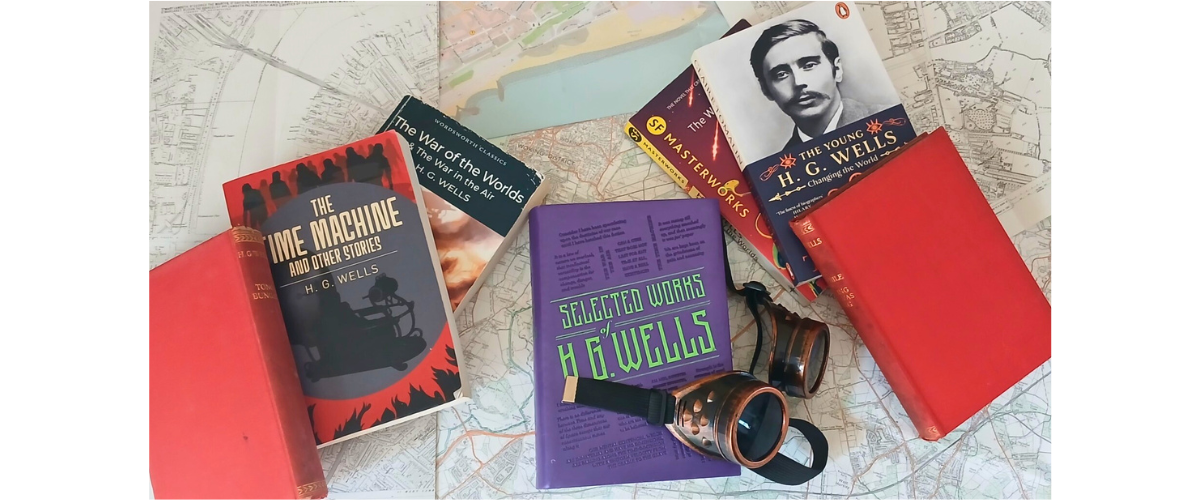
   Lately though I have found myself digging deeper into the life and works of HG Wells, who was born a couple of miles away from where I live in South East London. And this digging has been leading me to write and do quite a lot about him and his work.
   It started last summer when I was asked to devise a steampunk themed guided walk as part of the Vauxhall Victorian Day in South London. Vauxhall train station was the start point of the walk and that gave me the opportunity to point out the influence the South West Rail route to Waterloo from Woking had on the locations Wells has the Martian War machines destroy in the first part of the book. Wells was living in Woking at the time. The first Martian canister lands on nearby Horsell Common. The subsequent Martian progress towards London takes place at many of the towns and suburbs Wells would have passed on commuter journeys between Waterloo and Woking.
   Waterloo station and the area around it also play a pivotal role in the stories of both the narrator and his brother in the novel. I subsequently wrote a short blog about Waterloo in The War of the Worlds. https://lambethfantastical.blogspot.com/2024/09/lambeth-fantastical-september-2024.html
   Vauxhall Gardens was known as Vauxhall Pleasure Gardens in the Regency era and, amongst other things, was famed for its public and often record break hot air balloon ascents. That gave me an opportunity to talk there about how early scifi writers like Wells, Jules Verne and George Griffiths depicted hot air balloons and airships in many of their works. This later evolved into a Substack article on the subject. https://dturnbull.substack.com/p/lambeth-fantastical-episode-thirteen
   Having looked into the locations in The War of the Worlds I decided to visit some of them with a train ride to Woking to follow the HG Wells Heritage Trail. The town really celebrates their Wells associations. There's a plaque on the house he lived in, a statue of him in the town centre and nearby a towering sculpture of a three legged Martian war machine. Inside the HG Wells pub there's sculpture of the Invisible Man with his trademark bandages and dark glasses. Wells also wrote the Invisible Man while residing in Woking. My review of the Heritage trail formed the basis of another Substack.
https://dturnbull.substack.com/p/lambeth-fantastical-episode-ten
   Once I had Woking under my belt I decided to try and visit other homes that Wells lived in. I'm not sure which writer holds the record for the most plaques but I reckon Wells is in with a good chance. There are many, from his birthplace on Bromley High Street, to his three house in Sandgate on the Kent coast, and the apartments on the edge of Regents Park where he died in 1946. This has led to an online talk called "HG Wells Lived Here" which I will be giving on the Rest Less platform very shortly.
   I've now designed the routes for a series of HG Wells guided walks which I am in the process of trying out. The first of which you can find on Eventbrite.
https://www.eventbrite.co.uk/e/1377748716499?aff=oddtdtcreator
   The latest Wellsian well I have found myself digging into is the graphic novel interpretations of his work. Again there are many.
   In the 1940s Classic Comics launched their Illustrated Classics Illustrated series, which included graphic novelisations of the works of writers ranging from Jules Verne to Mark Twain, and even Shakespeare. The series ran for over 20 years and featured no less than 5 HG Wells works, including War of the Worlds and The Invisible Man.
   In the 70s Marvel had a similar series (Marvel Classics). This series was much more scifi focused and HG Wells again made 5 appearances. Another series ‘Great Illustrated Classics’ by the Waldman Publishing Corporation includes 3 Wells’ titles.
   The second book in The League of Extraordinary Gentlemen by Alan Moore and Kevin O’Neil is set during the War of the Worlds and also features the Invisible Man and Doctor Moreau. Scarlet Traces by Ian Edgington and the graphic artist D’Israeli recounts The War of the Worlds plot in Part 1 before visiting post invasion Edwardian society in Part 2 and steampunk style interplanetary warfare in Part 3.
Wells himself appears in the Stoker and Wells graphic novels by Stephen Peros and Barry Orkin where he teams up with Dracula author Bram Stoker to travel into the future in a stolen time machine. 
   Who knows how deep I will end up digging into this particular well and, equally, who knows what I might end up writing about or doing as a consequence.

Sunday, 13 October 2024

A Glimpse of the Ghostly: David Turnbull

The Black Beacon Book of Ghosts will send shivers up your spine this Halloween. The Kindle version is already available for pre-order at just $1.99 instead of $3.99 and you can add the anthology to your Goodreads "want to read" list today. The anthology will be officially released on the 11th of October 2024. To get you in the mood and give you a little insight into the workings of their minds, our contributing authors are sharing their own haunting experiences with you. Read on, if you're not fainthearted!

Ghost of the Necropolis by David Turnbull

On Waterloo's Westminster Bridge Road there stands an old Edwardian Office block, not far from Lambeth North tube station. If you fancy owning a piece of gothic history with a ghost story attached it is currently up for sale. The abandoned building is the last remaining remnant of what was once the Necropolis Railway.

The Necropolis Railway was opened in 1854 as a solution to overcrowding and unsanitary conditions in London's seven major public cemeteries, themselves built to tackle overcrowding in London churchyards following the population boom brought about in the city by the industrial revolution.

Coffins, corpses, and mourners would be transported from Waterloo to Brookwood, 18 miles away in Surrey, where 2,200 acres of land had been purchased for a gigantic cemetery. In true Victorian fashion you could make your journey to you final resting place in first, second, or third class, depending on your social standing.

One of the most notorious people transported from Waterloo and buried at Brookwood was Doctor Robert Knox who died in 1862. Knox had gained infamy as the surgeon who received murdered corpses from the Edinburgh grave robbers, Burke and Hare. As a result of the scandal following their trial, he'd been forced to relocate to London. His plot in Brookwood is one of the few that was concreted over. Clearly, given his experience of grave robbers, he wasn't taking any chances.

The office block was part of the Necropolis which was relocated in 1902 when South West Railways extended Waterloo station. Coffins continued to be transported to Brookwood up until World War Two, when bombing during the blitz left the station damaged beyond repair.

The building's ghost story has its origins a decade before the war started, when the railway was still fully operational. On the night of 14th March 1929 Police Constable David Ford entered the premises during a suspected burglary. Whilst carrying out his investigation he fell to his death through a skylight. Years later, when the offices were being utilised as a training centre for Transport for London, staff working late regularly reported hearing frantic footsteps running along corridors and up and down stairways, accompanied by the repeated banging of doors. It was believed to be the ghost of PC Ford eternally chasing his elusive burglar. Who knows, the new owners of the building may well find that this ghostly nocturnal chase is still going on.

Saturday, 12 August 2023

Horror Anthology: An Interview with David Turnbull

The Black Beacon Book of Horror will be released on Friday the 13th of October; the Kindle version is available for pre-order at just $1.99 instead of $3.99 and you can add the anthology to your Goodreads list today. To get you in the mood for a particularly spooky Halloween this year, we’re interviewing the contributing authors. The first Black Beacon Book of Horror is bound to give you the creeps!

Hi David,

Why do you write horror?

In simple terms because I am huge fan of the horror genre. I read it. I watch it on TV. I go to see it in cinemas. Probably all caused by watching episodes of the Twilight Zone and Friday night horror films on TV when I was growing up.

Is there a story behind your story in this anthology?

I’m claiming back Halloween for its Celtic roots. Trick of Treat didn’t start in America and get exported across the world. It started with the guisers in Scotland, Ireland and Wales. But the guisers in my story come from another world entirely, and the tricks they play are pretty unsettling.

Do you have an all-time favourite horror tale?

I suppose it would have to be Something Wicked This Way Comes by Ray Bradbury. I love the way Ray Bradbury writes and the motif of a sinister fairground visiting a small town is the perfect mix of the ordinary tainted by the uncanny. A book that scared me was The Rats by James Herbert, because it seemed plausible and possible. I remember reading the part where one of the characters is on a London Underground platform. He hears a thunderous roar coming from the tunnels, accompanied by a strong gush of air. But it is not an approaching train he’s hearing. It’s a ravenous horde of fresh eating rodents. Even now, many years later, I can’t sit on a tube station platform without getting a flashback of the imagery of that scene.

What books did you grow up reading?

I was an avid reader of the Pan Book of Horror Stories series. Those really got me into a love of short stories, particularly horror stories.

Do you have any writing rituals?

I usually write stuff at my PC sometime during the day and then edit it in bed on my laptop first thing in the morning.

Would you share something about yourself that your readers don’t know yet?

I have recently qualified as a guide with the Lambeth Tour Guides Association and I have developed a number of walks which take in film and TV locations as well as writers and novels associated with different part of South East London.

Where can we find you online?


Thanks for answering our questions! 

Friday, 23 December 2022

A Post-Apocalyptic Interview with David Turnbull

Our next anthology, Tales from the Ruins, is going to be a cataclysmic one! It will be released on the 25th of February but the Kindle version is available for pre-order today at just 99c instead of $3.99. To celebrate the imminent publication of the first Black Beacon Books anthology exclusively dedicated to post-apocalyptic fiction, we’re interviewing the contributing authors. Behold the maniacal workings of their troubled minds!

Hi Tumsh,

Let’s make the first question a lighthearted one...hmm...okay, got it! Is your story simply an entertaining piece of fiction or are you giving us a peek at the terrifying fate tomorrow will unleash upon us? 

Humanity seems to have an unlimited capacity for finding reasons to fight each other, whether it’s ideology, religion, or territory. I’m looking at what would happen if the state broke down and private armies deteriorated into warring factions, fighting over ever decreasing enclaves under their control. To me that is a terrifying scenario, but one which seems very possible given what is happening globally.

What is it that makes post-apocalyptic fiction so appealing? Would the world be better off if more people read this genre?

I think post-apocalyptic stories are cautionary tales. They serve a similar purpose as traditional folk tales, warning us of the dire consequences of following a certain course of action.

Do you have a favourite post-apocalyptic author? 

I’m going to go for Adam Roberts, and two books of his. Firstly ON, published in 2001. It has great premise. The world has shifted on its axis and the centre of gravity has changed. The surface of the Earth is now a wall with a vast, endless drop and people live on the ledges that were once the sides of mountains. The main character falls from the ledge where his village is and finds himself pressed
ganged into an army engaged in a conflict between warring Popes. The second is New Model Army, published in 2010, where a network of wireless connections, the internet and CCTV, called Pantegral, unleashes a skewed democratic form of conflict where anyone at all can take up arms and become a soldier.

Some people like to listen to music while reading. Which song can you imagine providing the soundtrack to your story?

Given the theme and location of my story it would have to be London Calling by The Clash. Also the title of my story was drawn from their album track, English Civil War.

If you woke up in your story tomorrow, what would you do? 

I would probably jump in the 181 bus that features in my story and drive as far away from the centre of the conflict as possible, avoiding getting taken out by surface missiles.

There are no firearms or ammunition. You have to choose an everyday object from the home or garden as your weapon of choice—what’s in your hands?

Probable a steak hammer. It’s light and easy to carry, but it can do a lot of damage. It would be useful both as a weapon and as a tool. If push comes to shove, it could also be thrown at an advancing assailant.

Time to get more personal. Tell us three interesting facts about yourself.

I just took early retirement but up until a month ago I was a national official
for one of the UK’s largest trade unions.

I am currently training to be a tour guide. My course project is Waterloo in Time and Relative Dimension. A guided walk that looks at all sorts of connections the Waterloo area in South East London has with SciFi, Horror and Fantasy fiction.

Before all of that, I was a Chef. I have worked in clubs, casinos, hotels, and banqueting venues. I once worked a summer season in a holiday camp that was half a mile away from a nuclear power station.

What do you aim to give your readers?

I want to provoke some thought. In my story, I wanted to look at how war can dehumanise child soldiers and the ways civilians caught up in conflict find to cope.

What are you working on now?

I’m working on a horror novella set in the swinging 60s. It’s called the Hurdy Gurdy Man and it draws inspiration from the Grimms’ Fairy Tale Fischer’s Bird.

Where can we find you online?

My website is www.tumsh.co.uk
In case you are wondering, Tumsh is a nickname from the Scottish Border that used to be given to anyone with the surname Turnbull.

Editor's note: David and I are almost certainly distant cousins since we both have Turnbull ancestry. The Turnbulls controlled land around the town of Selkirk. Interestingly, the lifestyle of the border families over several centuries wasn't that different from what's described in David's short story set in a post-apocalyptic London. If you'd like to learn more about the "border reivers", George MacDonald Fraser's book, Steel Bonnets, is a riveting read.

Thanks for playing along. Good luck in the wastelands!