Showing posts with label steampunk. Show all posts

Monday, 18 May 2026

Fortitude and Courage Competition - June 2026


Do you like your fiction full of adventure, intrigue, and with strong female protagonists? That's what Karen Bayly does best! For your chance to win a print copy of both Fortitude and Courage, simply send the answer to this question to blackbeaconbooks@gmail.com before the date in question.

What remarkable event took place in London two hundred years ago on the 28th of June, 1826?


Thursday, 28 August 2025

A Steamy Interview with David Turnbull

Steampunk Sleuths will be released on the 30th of August (but the Kindle version is available for pre-order today at just $1.99 instead of $3.99). You can also add it today to your Goodreads bookshelf. To celebrate this anthology that perfectly aligns the gears that drive the genres of steampunk and mystery, we’re interviewing the contributing authors. Don your aviator goggles, but keep your magnifying glass close at hand, because these steamy puzzles won’t solve themselves!

Hi David,

There’s nothing quite as captivating as a great detective story, but what specifically is it about mystery in a steampunk world that gets your gears turning?

The early pioneers of science fiction, Jules Verne, George Griffiths, HG Wells and others were imagining a future based on the latest technical advances of the Victorian era. In contrast present day writers in the steampunk genre get to go back in time and reimagine the past based on how they see the technology might have developed in alternate versions of history. It's interesting for me to step back into that historical era and adopt the what if? premise originally adopted by those pioneers and see where that might take a story, particularly one with a mystery waiting to be solved.

Tell us about your protagonist. Is this the first puzzle your main character has solved? 

My protagonist is an infantryman horribly wounded by a heat ray during a Victorian-era Martian invasion of Earth (based on HG Wells' The War of the Worlds). In the aftermath, as London is rebuilding out of the ruins, he finds himself working as an assistant to Yil, a Martian detective who is a refugee from the civil war raging back on Mars. They are hired by an elderly criminal, Jack Dawkins (aka the Artful Dodger) who wants them to investigate the kidnapping of several members of his gang of street urchins.

One of my favourite steampunkish novel is Kim Newman's Anno Dracula, which is based on the premise that Dracula was not defeated in the manner he was in Bram Stoker's original novel, but instead becomes prince consort to Queen Victoria and sets about converting the British Empire to vampirism. Newman weaves both historical and fictional characters from the era into his narrative. I tried a similar approach with Private Ornshaw and the Martian Detective, dipping into Edgar Rice Burroughs' John Carter Martian novels and Ray Bradbury's Martian Chronicles as well as The War of the Worlds for inspiration. For example, the wasp gun which is detective Yil's favoured weapon is based on the weapon used by the Martians in the Martian Chronicles. One of the original characters I've introduced into the plot is Madam Macaque a former circus performer who harbours a huge grudge against her fellow humans and is in league with the amphibious tentacled race of Martians who were responsible for the invasion. But what has all of this to do with missing street kids? You'll need to read the story when it's published to uncover that mystery.

It’s time for Show and Tell! What’s the most steampunk antique, item of clothing, book, game, or household item you have?

I'm not entirely sure if this qualifies as steampunk, but I feel it could provide an excellent backdrop and setting for a steampunk story. I have a book from 1887 called China's Millions. It's a collection of editions of China's Millions, the regular journal of the China Inland Mission. It contains letters, accounts and articles from the British protestant missionaries who set up a vast network of Christian missions in China between the Opium Wars and the Boxer Rebellion. They give fascinating insights into what China was like in the 1880s. I'd love to take all the detail in the accounts laid out in the book and work them into a steampunk plot, probably with some clockwork automata robots thrown in for good measure. But the big challenge would be how to achieve this without inadvertently reverting to some stereotypical Fu Manchu villain as the main antagonist, or engaging in cultural appropriation if I made a Chinese character the protagonist.

Where can we find you online?

Look for Lambeth Fantastical on Facebook, SubStack and Blogger.com and you’ll find stuff about my writing and scifi, horror, and fantasy themed guided walks.

Thanks for playing along!

Image credit: https://archive.org/details/chinasmillions1883chin

Friday, 22 August 2025

A Steamy Interview with Diana Parrilla

Steampunk Sleuths will be released on the 30th of August (but the Kindle version is available for pre-order today at just $1.99 instead of $3.99). You can also add it today to your Goodreads bookshelf. To celebrate this anthology that perfectly aligns the gears that drive the genres of steampunk and mystery, we’re interviewing the contributing authors. Don your aviator goggles, but keep your magnifying glass close at hand, because these steamy puzzles won’t solve themselves!

Hi Diana,

There’s nothing quite as captivating as a great detective story, but what specifically is it about mystery in a steampunk world that gets your gears turning?

Steampunk, as a genre, blends Victorian-era aesthetics and technology with speculative, often anachronistic inventions powered by steam and clockwork. It’s not just a reimagining of the past or a vision of the future, it feels like stepping into another dimension altogether. This fusion of a bygone era with futuristic possibilities creates a world that’s both familiar and fantastical, which really fires up my imagination. For me, writing begins when something resonates—whether it’s a setting, an object, or a tune—anything that strikes a chord. That spark is all I need. I’m too easy.

Tell us about your protagonist. Is this the first puzzle your main character has solved?

My protagonist isn’t solving her first case, but that doesn’t automatically make her sharper or more confident. Every case is its own kind of challenge. She’s developed her own methods through experience, but she still makes mistakes. She’s human, after all. Human interaction is just as crucial to solving the mystery as it is distracting, sometimes causing her to overlook details or feel things when only a cool-headed approach should prevail. She’s not so different from the reader, because I, the writer who created her, am also a reader who enjoys mysteries.

It’s time for Show and Tell! What’s the most steampunk antique, item of clothing, book, game, or household item you have?

For my most steampunk item, I combined a few favorites that set the mood: a vintage-style notebook perfect for sketching secret plans, classic leather gloves, an ornate lamp that looks like it belongs in a foggy Victorian study, and a plastic revolver that adds a touch of airship adventure. I also included two books—The Moonstone and Persuasion—to bring a bit of mystery and period atmosphere to the scene. It’s not one single artifact, but together they capture the spirit of steampunk for me.

And since I’m also a gamer, I’ll add that I own Dishonored and Thief on Epic Games, not exactly traditional steampunk, but close enough in tone: moody cities, shadowy tech, and lots of morally ambiguous detectives. That counts, right?

Where can we find you online?

You can find me online pretty much everywhere I dare to show up. I’m on YouTube as a proud gamer, on Amazon Author Central under my real name, Diana Parrilla, and on X (Twitter). I’m a bit quieter on Instagram and Facebook, but I’m there too, everywhere under the alias buffyta17. Feel free to track me down wherever you like.

Thanks for playing along!

A moment from my playthrough of Thief (2014)

Saturday, 9 August 2025

A Steamy Interview with Cameron Trost

Steampunk Sleuths will be released on the 30th of August (but the Kindle version is available for pre-order today at just $1.99 instead of $3.99). You can also add it today to your Goodreads bookshelf. To celebrate this anthology that perfectly aligns the gears that drive the genres of steampunk and mystery, we’re interviewing the contributing authors. Don your aviator goggles, but keep your magnifying glass close at hand, because these steamy puzzles won’t solve themselves!

Hi Cameron,

There’s nothing quite as captivating as a great detective story, but what specifically is it about mystery in a steampunk world that gets your gears turning?

A great fair-play mystery story is built from a handful of essential nuts and bolts... and a few cogs! My contribution to the anthology is that most prized of puzzles; the locked-room mystery. What really got the little grey gears of my mind turning for this particular story, The Untimely Death of Clockmaster Tollsmead, was the prospect of conjuring a clockwork means of committing a murder in a locked room. Not only did I want the solution to fit perfectly with the setting in a Victorian clockwork society, but also to reflect present-day concerns the reader will be familiar with.  

Tell us about your protagonist. Is this the first puzzle your main character has solved?

This is only the second story (both locked-room mysteries) featuring my clockwork technician protagonist, Eardley Holborn. The first adventure is referenced within this story, so readers who enjoy this tale can do a little detective work of their own and track down the anthology featuring the first. Eardley isn't a professional detective or even really an amateur sleuth. This is simply the second time he has found himself in the right place at the right time to solve a crime. He is Chief Clockwork Artist at the Urseau Institute of Mechanical Theatrics, so his job is to create magic shows and edge-of-the-seat tricks for stage performances. Readers familiar with the British TV show Jonathan Creek might (rightly) guess from whence I drew part of my inspiration. 

It’s time for Show and Tell! What’s the most steampunk antique, item of clothing, book, game, or household item you have?

My pocket watch is without a doubt the item that best represents the atmosphere of this puzzle and Eardley Holborn's style. Eardley's appearances are never untimely.

Where can we find you online?

Everywhere! My official website is camerontrost.com but you can find my social media links at LinkTree.

Thanks for playing along!

Thanks for having me!

Monday, 4 August 2025

Digging Deeper into Wells

A guest post by David Turnbull

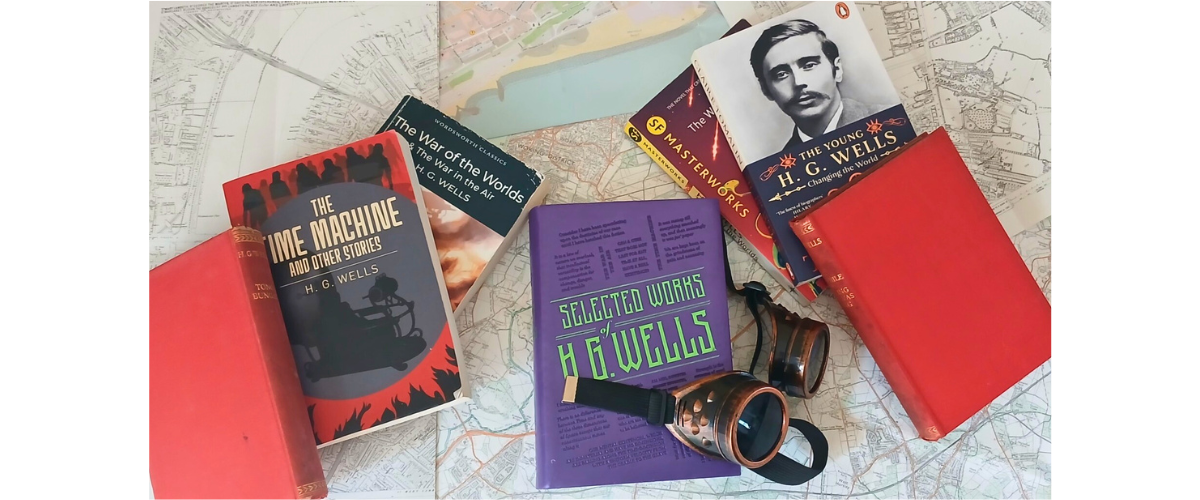
I'm proud to have a novella included in the upcoming Black Beacon Steampunk Sleuths anthology. It's set in the aftermath of the Victorian-era alien invasion depicted in HG Wells pioneering scifi classic, The War of the Worlds.
   I seem to have been aware of War of the Worlds for as far back as I can remember. My first exposure was watching the 1953 George Pal film version sometime back in the late 60s or early 70s. That led to my first reading of the novel in a paperback I borrowed from a school friend. The biggest revelation was that the Martian war machines had three legs, unlike the flying saucer design George Pal had come up with for the movie.
   I know for sure I reread the novel in 1978 when Jeff Wayne first released his War of the Worlds concept album. Since then I have been back to the novel a dozen or more times, as well as being an avid watcher of new film and television adaptations, and the whole gambit of War of the Worlds inspired alien invasion films and TV shows.
   Lately though I have found myself digging deeper into the life and works of HG Wells, who was born a couple of miles away from where I live in South East London. And this digging has been leading me to write and do quite a lot about him and his work.
   It started last summer when I was asked to devise a steampunk themed guided walk as part of the Vauxhall Victorian Day in South London. Vauxhall train station was the start point of the walk and that gave me the opportunity to point out the influence the South West Rail route to Waterloo from Woking had on the locations Wells has the Martian War machines destroy in the first part of the book. Wells was living in Woking at the time. The first Martian canister lands on nearby Horsell Common. The subsequent Martian progress towards London takes place at many of the towns and suburbs Wells would have passed on commuter journeys between Waterloo and Woking.
   Waterloo station and the area around it also play a pivotal role in the stories of both the narrator and his brother in the novel. I subsequently wrote a short blog about Waterloo in The War of the Worlds. https://lambethfantastical.blogspot.com/2024/09/lambeth-fantastical-september-2024.html
   Vauxhall Gardens was known as Vauxhall Pleasure Gardens in the Regency era and, amongst other things, was famed for its public and often record break hot air balloon ascents. That gave me an opportunity to talk there about how early scifi writers like Wells, Jules Verne and George Griffiths depicted hot air balloons and airships in many of their works. This later evolved into a Substack article on the subject. https://dturnbull.substack.com/p/lambeth-fantastical-episode-thirteen
   Having looked into the locations in The War of the Worlds I decided to visit some of them with a train ride to Woking to follow the HG Wells Heritage Trail. The town really celebrates their Wells associations. There's a plaque on the house he lived in, a statue of him in the town centre and nearby a towering sculpture of a three legged Martian war machine. Inside the HG Wells pub there's sculpture of the Invisible Man with his trademark bandages and dark glasses. Wells also wrote the Invisible Man while residing in Woking. My review of the Heritage trail formed the basis of another Substack.
https://dturnbull.substack.com/p/lambeth-fantastical-episode-ten
   Once I had Woking under my belt I decided to try and visit other homes that Wells lived in. I'm not sure which writer holds the record for the most plaques but I reckon Wells is in with a good chance. There are many, from his birthplace on Bromley High Street, to his three house in Sandgate on the Kent coast, and the apartments on the edge of Regents Park where he died in 1946. This has led to an online talk called "HG Wells Lived Here" which I will be giving on the Rest Less platform very shortly.
   I've now designed the routes for a series of HG Wells guided walks which I am in the process of trying out. The first of which you can find on Eventbrite.
https://www.eventbrite.co.uk/e/1377748716499?aff=oddtdtcreator
   The latest Wellsian well I have found myself digging into is the graphic novel interpretations of his work. Again there are many.
   In the 1940s Classic Comics launched their Illustrated Classics Illustrated series, which included graphic novelisations of the works of writers ranging from Jules Verne to Mark Twain, and even Shakespeare. The series ran for over 20 years and featured no less than 5 HG Wells works, including War of the Worlds and The Invisible Man.
   In the 70s Marvel had a similar series (Marvel Classics). This series was much more scifi focused and HG Wells again made 5 appearances. Another series ‘Great Illustrated Classics’ by the Waldman Publishing Corporation includes 3 Wells’ titles.
   The second book in The League of Extraordinary Gentlemen by Alan Moore and Kevin O’Neil is set during the War of the Worlds and also features the Invisible Man and Doctor Moreau. Scarlet Traces by Ian Edgington and the graphic artist D’Israeli recounts The War of the Worlds plot in Part 1 before visiting post invasion Edwardian society in Part 2 and steampunk style interplanetary warfare in Part 3.
Wells himself appears in the Stoker and Wells graphic novels by Stephen Peros and Barry Orkin where he teams up with Dracula author Bram Stoker to travel into the future in a stolen time machine. 
   Who knows how deep I will end up digging into this particular well and, equally, who knows what I might end up writing about or doing as a consequence.

Thursday, 24 July 2025

A Steamy Interview with Karen Bayly

Steampunk Sleuths will be released on the 30th of August (but the Kindle version is available for pre-order today at just $1.99 instead of $3.99). You can also add it today to your Goodreads bookshelf. To celebrate this anthology that perfectly aligns the gears that drive the genres of steampunk and mystery, we’re interviewing the contributing authors. Don your aviator goggles, but keep your magnifying glass close at hand, because these steamy puzzles won’t solve themselves!

Hi Karen,

There’s nothing quite as captivating as a great detective story, but what specifically is it about mystery in a steampunk world that gets your gears turning?

Steampunk provides the allure of devious machines and black-hearted cads lurking under the veneer of gentile, Victorian manners. It’s an excellent background for the weird and wonderful.

Tell us about your protagonist. Is this the first puzzle your main character has solved?

Serendipity Windlass is a strong-minded and intelligent young woman who has grown up surrounded by brilliant minds. This, and the fact that she has a rather unusual bio-mechanical leg, sets her apart from other men and women her age. Her best friend, Uncle Ambrose, who is a long-time friend of her father rather than a real uncle. He is the left-of-centre doctor who created her leg, and, in this story, she travels to Whitby on an errand for him. A murder at the guesthouse where she stays and a chance meeting with a famous author leads her to consider a new path in life.

It’s time for Show and Tell! What’s the most steampunk antique, item of clothing, book, game, or household item you have?

This book and hat are the most steampunk items I own. I bought the hat online and it doesn’t fit (too small) so I have never worn it.

Where can we find you online?

Thanks for playing along!


Wednesday, 16 July 2025

A Steamy Interview with S. B. Watson

Steampunk Sleuths will be released on the 30th of August (but the Kindle version is available for pre-order today at just $1.99 instead of $3.99). You can also add it today to your Goodreads bookshelf. To celebrate this anthology that perfectly aligns the gears that drive the genres of steampunk and mystery, we’re interviewing the contributing authors. Don your aviator goggles, but keep your magnifying glass close at hand, because these steamy puzzles won’t solve themselves!

Hi S. B.,

There’s nothing quite as captivating as a great detective story, but what specifically is it about mystery in a steampunk world that gets your gears turning?

Steampunk is a genre that offers nearly limitless possibilities. The only real qualifier is the energy-systems in use, and the feel. Pulp adventure, historical, romance, horror, mystery, fantasy, or a blend of all these things and more can easily fit into a satisfying steampunk story. I really enjoy that wide-open flexibility.

Of course, on the non-technical side, steampunk is just flat out cool. I am the sort of guy who still, even in my adulthood, has dreams about monstrous industrial machinery and huge commercial buildings that go on and on, woven with pipes and gears and weird motors… Nightmare-fuel liminal stuff. When I was younger, these dreams used to terrify me, but now that I’m older I’ve started to enjoy them. Basically, they’re steampunk. Having the opportunity to write a story set in a world like that was a special treat.

Tell us about your protagonist. Is this the first puzzle your main character has solved?

The protagonist in “Tears of the Dragon” is a geisha living in a very alternate history Edo Japan, named Aoyama Ohatsu. Though young herself, she already has a younger geisha-in-training that looks up to her. Living in a strict feudal society, Ohatsu must balance her sense of place and self against her duties as a professional entertainer. Of course, when her house-sister goes missing, Ohatsu’s loyalties to that very caste system are the first things that are tested.

I really enjoyed writing Ohatsu. To me, she was clever, emotionally intelligent, and generous. That being said, because of her place in society, I think it’s unlikely she’ll find herself in the middle of another mystery anytime soon… But then again, who knows?

It’s time for Show and Tell! What’s the most steampunk antique, item of clothing, book, game, or household item you have?

That would probably be this weird clamp-magnifying-glass thing I was gifted years ago. It serves no real functional purpose, just looks cool on my shelf. I’ve only ever used it rarely… but, now that I mention it, I have an idea…


Where can we find you online?

You can find me online at SBWatson.com, on X at SBWatsonMystery, Facebook as S. B. Watson, Instagram at sbwatsonmysteries, and on Goodreads as Theodore Berkawitz Meshak Sibelius the Fourth… Just kidding. On Goodreads I’m—you guessed it—S.B. Watson.

Thanks for playing along!

Thanks for having me!

Tuesday, 10 June 2025

Writing Mystery in a Steampunk World

A Guest Post by Diana Parrilla

I came to steampunk through mystery. Not just the genre, but the idea of mystery itself. And for someone like me, someone who writes stories tangled in secrets and lies, it's the perfect setting. What I love about it is how it walks a line: part historical, part reimagined. You get to rewrite the past, but you still stay tethered to it. There's structure, and most of all, atmosphere. You can't just toss logic out. If anything, you need more of it. The gears have to turn. The world still has to make the same kind of sense as our own. It's a brilliant place to drop a murder. Although, if you ask me, anywhere's a good place for that.

But writing mystery in a steampunk world isn't just about adding brass and fog. It's about shifting how information works. In a contemporary setting, you'd be dealing with phone records, CCTV, and timestamps. In a steampunk world, you can decide those things never existed. No surveillance footage. No GPS trail. People vanish and there's nothing to rewind. Witnesses can lie with far less risk of being caught. And in theory, that makes things easier. For the characters, for the plot, maybe even for the writer. No cameras means secrets stay hidden a little longer, and the lack of evidence is easier to justify for the reader.

As a writer, I never get tired of picking apart my own stories. I try to be as critical as possible, finding logic flaws, questioning motives, making sure every step makes sense in my head. Why didn't he do that? Why would she go there? What's missing? In real life, we do things without much thought. Honestly, we do most things that way. If we didn't, we'd probably be less human. But on the page—especially in mystery—readers look for reasoning. They expect logic behind each decision, even the bad ones. Every action has to carry motive. And so does every moment of hesitation, every failure to act. But the thing is, I don't want it to be easy. Not really. Part of the thrill in writing these stories is making it difficult for myself. I want to back myself into corners. I want to write something that feels like it's unraveling faster than I can hold it together, and then find the thread that ties it all back up.

Every story, for me, is a challenge. Sometimes a quiet one, sometimes a full-blown battle. And not just against the plot. Sometimes it's the characters themselves. They refuse to follow the script. They know something I don't, and they make me work for every clue. That's what makes it satisfying. Writing mystery in this kind of setting means leaning into the strange logic of it. The possibilities expand, not because you've removed rules, but because you've replaced them with new ones.

For anyone who loves mystery and speculative fiction, steampunk is a space where you get to pull both threads at once. You can build the impossible, then ask what would happen if someone used it to commit a crime. Or hide one. Or solve one. And that's why I stay here, in this soot-streaked, gear-cranked corner of fiction. It's not just the aesthetic. It's the tension, the challenge of telling a story that might fall apart if one screw comes loose, but holding it together anyway, just long enough to deliver the truth.

#

You'll be able to read The Copper Train by Diana Parrilla in Steampunk Sleuths, out August the 30th. You can find her online at https://linktr.ee/buffyta17


Tuesday, 20 May 2025

Heart and Soul: Greg Chapman on the difference between Photomanipulation and Artificial Intelligence

As a trained graphic designer (I have a Diploma in Graphic Design and have 25+ years’ experience) and visual artist, I put in a considerable amount of thought – and heart – into my book cover designs and illustrations.

So, how are book covers made? Each artist or designer has their own way of doing it, I primarily work in the area of photomanipulation. One might ask, how is this different to using generative A.I.?

For me it comes down to how a cover is composed. I use royalty free, CC0 or public domain imagery to create my covers. I take existing images and compose them into an eerie, evocative image. I try and use the adage of “’less is more” focusing on a central point of reference.

My inspiration comes from other covers and artists, or just the images themselves, but my goal is always to take a static image or images and expand them into a montage that might tell a story or give a sense of what the book might contain.

I make a lot of pre-mades, because, well, I just love making them. I enjoy forcing images together. I also do covers on request, so I thought I’d share a cover I’ve done for Cameron at Black Beacon Books.

Take the cover for Steampunk Sleuths (out August the 30th) for example:


When designing, the art and typography always go hand in hand. You shouldn’t really consider one without the other.

This design is made up of the following images that I sourced from CC0 websites… including Pixabay, Pexels and Unsplash.

Figure 1: An existing piece of steampunk aircraft

Figure 2: I liked the tunnel glimpse of the London skyline for the background

Figure 3: This guy's coat just screamed "detective"

Figure 4: The perfect steampunk hat


Figure 5: I stole the head off this image and painted on a moustache and monocle

By using all these images and cutting them up and compositing various the pieces into a whole, I’ve created a whole new image. Something that didn’t exist before. I’ve thought carefully about how they all fit together and also considered colour, mood, texturing, lighting and most importantly matched the image to the themes of the anthology: steampunk and mystery.

It probably from memory took me 1-2 days to create. Of course some might prefer to let a gen-AI do all this work. Sure it might do it in seconds but it will simply spit out an amalgamation of hundreds, potentially thousands of pieces of stolen art. There won’t be any thought put into it, no skill, no dedication to what makes a cover interesting and inviting.

Ultimately book cover designers are real people. People who read books, appreciate story and art and what makes a book special.

Please consider using a real person for your next book.

Thank you.

Monday, 18 November 2024

Steampunk Sleuths Update

The table of contents for our first novelette anthology has been finalised. Steampunk Sleuths will be published on the 18th of July next year and will feature the following stories set in a steampunk world. Each adventure will have an appropriately quirky crime or mystery at the centre of its plot, and as well as steam-powered vehicles and clockwork machinery, you might just bump into pirates, samurai, vampires, and extra-terrestrials!

Tears of the Dragon by S.B. Watson

Murder in Whitby by Karen Bayly   

The Untimely Death of Clockmaster Tollsmead by Cameron Trost

The Copper Train by Diana Parrilla

The Strange Case of Private Ornshaw and the Martian Detective by David Turnbull


Thursday, 14 November 2024

Trailblazing Women - Karen Bayly

Karen Bayly shares the real-life inspirations behind her steampunk adventuress Artemis Devereaux with us over on her website and Black Beacon Books gives you, Dear Reader, the chance to win a print copy of her novels, Fortitude and Courage, simply by answering the question at the end of this post.


TRAILBLAZING WOMEN by Karen Bayly

In my latest novel, Courage, Artemis Devereaux stops over in Terra Australis, after flying her dirigible Taygete solo over much of the world. She had done similar journeys previous, but never solo, and I was determined she should fully spread wings after her journey toward independence in Fortitude.

Like all authors, some of my character’s drams and skills represent my own. I have wanted to learn to fly since my teens. However, the cost of flight tuition was more than I earned. Other avenues such as air force pilot weren’t open to women when I was young enough to take advantage of the opportunity. Now, I still can’t cover the cost of flight tuition, but even if I could, my failing eyesight might make things difficult.

Read Karen's full post on her website blog in order to answer the question below. Answer the question as a comment on this post or on any of our social media posts for the competition. A winner will be randomly selected at the end of the month.

Question:
What is the name of the reporter who beat the fictional record set by Phileas Fogg?

Tuesday, 2 January 2024

Fortitude and Courage: Double Cover Reveal

Adventure time! All aboard! We're thoroughly delighted to unveil Malgorzata Mika's cover art for our first releases in 2024, two action-packed steampunk romps by Karen Bayly. These books are for all the readers who love airships, steampunk science, fantastic adventure, and an unforgettable and intrepid heroine - Artemis Devereaux! That means ALL readers, right? Out February the 13th. 

Find Karen on Facebook, Twitter, and Instagram

Find Malgorzata on Twitter and Instagram


Monday, 1 January 2024

A Mysterious Year: Anthology Submissions

Welcome to 2024! Black Beacon Books has another big year planned in terms of publications and submissions windows. First up, let's announce two anthologies that will be open for submissions. This year, we're getting more mysterious than ever! 


Steampunk Sleuths

Deadline: October 31st, 2024

The genre of mystery is designed to get the cogs cranking, but let's not forget that steampunk is all about cogs too! Why not bring them together? Steampunk Sleuths will be an anthology of four novelettes (15 - 20,000 words) featuring detectives in a steampunk setting solving peculiar crimes. The only requirements for submission will be that the means of committing the crime (murder, theft, kidnapping...) must be clearly steampunk and the reader must be given the tools to crack the case before the solution is revealed. Think Agatha Christie and Jules Verne getting kinky together... um, actually, please don't. ;) 

* Previously unpublished only

* Double the standard rate for this one: $50 USD


The Third Black Beacon Book of Mystery

Deadline: Extended Deadline September 30th, 2024

WINDOW CLOSED

You've all read the first two volumes, right? The idea of this anthology series is to make each volume more gripping, more memorable, and more mysterious than the last. We're looking for short stories with an unforgettable protagonist and a clever puzzle to solve. Standard anthology conditions apply as per the Submissions Page


Please read and follow our guidelines on the submissions page.


Friday, 6 October 2023

Fortitude and Courage - Announcement and Interview - Part Two

Hello there, avid reader. You've read part one of the Fortitude and Courage announcement and you're back for the next round of steampunk tennis between Karen Bayly and Cameron Trost. Glad you could make it. Just give us a minute to warm up a little first... Okay, are you ready, Karen? Great! Let's play! 

C: What is your writing process like? Are you more of a plotter or a pantser?

K: I do a basic plot, so I know what plot points to hit to reach the end. After that, I’m a pantser. If I were to plot every little thing, I would never write a novel. I can get too tied up in the details and end up strangling the story. I also find that within the plot, the interaction of the characters drives some aspects of the story. Artemis and Nathaniel are the perfect examples. How they end up is not what I planned.

K: What’s your editing process?

C: I get the book formatted the way I want it first so that it’s print-ready, then I do a quick edit on the laptop, fixing up typos, punctuation mistakes, and aiming for consistency. The idea is to remove simple errors that will distract me from diving into the book. Once it looks fairly clean, I order a print copy, grab a red pen, and make myself comfortable so I can scribble away, adding notes and scratching out words or entire sentences that need to be removed or rewritten. The final step in editing an anthology is usually adding the page numbers, because this is what inevitably changes until everything is in the right place, and no editor wants a reader to point out that the story supposed to start on page twenty-seven actually starts on page twenty-eight!

C: What do you need in your writing space to help you stay focused? 

K: Quiet. 

K: What keeps you focused on editing?

C: Quiet or music of my choosing. I love editing, so as long as I have no external distractions or disturbances, I’m in the zone.

C: How do you celebrate when you finish your book? 

K: I don’t! I probably should. I’m partial to good peaty whisky. And champagne. Or a fine red wine.

K: How do you celebrate when you publish a book? 

C: By plastering posts all over social media! Then the peaty whisky. ;)

C: What is your kryptonite as a writer?

K: Self-doubt. It can be crippling.

K: What frustrates Black Beacon Books as a publisher?

C: What annoys me is when I receive a submission from an author and it’s immediately clear the guidelines haven’t been followed. It’s rude and it dramatically reduces your chances of getting an acceptance. But more than that, what really frustrates me is not selling hundreds of books each week—or even each month! We publish books for people to read, and we want as many readers as we can get!

C: Are you active on social media? How do you use it?

K: I’m relatively active. I share upcoming publications and posts from valued authors and publishers. When I have a long enough lead time, I share my writing process for a story and snippets of what inspired me.

K: What’s your social media strategy?

C: I try to repeat what I notice works and I try to post regularly with the aim of making our loyal fans feel appreciated while at the same time reaching new potential fans. I lean more heavily towards Facebook and Instagram, because they seem to work, and I promote Goodreads page as it’s a book-specific platform. We’re still on Twitter for the moment but it looks like Bluesky might be slowly gaining ground. There’s no big strategy. The idea is to have fun and include others in our adventure. We publish a lot of dark fiction but I try to keep our social media interactions positive and engaging. That’s what readers seem to want.

C: Do you play music while you write—and, if so, what’s your favourite?

K: No, I find music distracting as I tend to listen to it rather than write. The exception is Philip Glass’s Tirol Concerto for Piano and Orchestra 2nd Movement, which always evoked a strong sense of the Fortitudo and Nathaniel and Artemis’s troubled relationship.

K: What does Black Beacon Books need to get down to the business of publishing?

C: I guess this question can be understood a number of ways. Keeping in mind that Black Beacon Books is essentially me—Cameron Trost—running the show from my cottage in Brittany in my free time. At the nuts-and-bolts level, I need time alone to run things—that includes keeping the website and social media platforms updated, reading submissions, editing and formatting books, choosing cover artists or designing covers in-house, and much more. Beyond my laptop, however, Black Beacon Books becomes a team effort. Our aim is to sell copies so we can keep publishing more books, and we need our contributing authors to help us. We expect them to play an active role in promoting our titles so that we can succeed together. 

C: What books did you grow up reading?

K: The classics – Dickens, Austen, the Brontes, Lewis Carrol, Kenneth Grahame, lots of horse stories (!), fairy tales (I have an excellent book of fairy tales which is over 80 years old and passed down from my mother), and Greek and Norse mythology. I moved into science fiction and horror in my teens – starting with “The Chrysalids”, which we read in the first year of high school and progressing to the Pan Books of Horror. There are still stories from that series that haunt me - The Copper Bowl, The Emissary, Man Skin {shiver}.

K: What books have influenced Black Beacon Books in the development of its catalogue?

C: A tough question. None specifically and countless books more generally. Our anthologies are designed to intrigue, entertain, and thrill. If you take the Pan Books of Horror and mash them up with the Alfred Hitchcock anthologies, you’ll get an idea of the foundations we’re built on.

C: Have you ever tried to write a novel for a genre you rarely or never read? 

K: I haven’t written whole novels, but I’ve written short stories in genres I rarely read. Apparently, I can write decent romance and erotica, which is weird because I have zero interest in either. However, people like that stuff, so I work elements of both into my novels when appropriate.

K: What genres would you never publish?

C: It’s important to think about brand—I know, uncool business concept as opposed to cool artist term, but it’s not going to help us if we spread ourselves too thin. Our bread and butter—well, we’re stilling working on the butter—is suspenseful fiction and all the genres it encompasses. While a hint of romance and a dash of eroticism can spice up a gripping tale, we’re not interested in giving Mills & Boon (they still around?) a run for their money, and “50 Grades of Shay”...well, no comment. We’re not planning on branching out into high fantasy or hard sci-fi either. 

C: What book (or books) are you currently reading? 

K: This changes every five days or so, so it will be outdated by the time anyone reads this. I’ve just finished Dervla McTiernan’s “The Murder Rule” and am now reading Sylvain Neuvel’s “A History of What Comes Next”.

K: What are the top five books in your To Be Read list?

C: I have two lists of books to read; one mostly made up of print books I’ve ordered (living in rural Brittany means my books in English are ordered online) and the other made up of ebooks I’ve been asked to review by fellow authors. Of the latter, my priorities are reviewing “A Vindication of Monsters”, edited by Claire Fitzpatrick, and “Cretaceous Canyon” by Deborah Sheldon. Of the former, well, I’m currently reading “Charlotte Sometimes” by Penelope Farmer, which is the book one of my favourite songs is based on, then there’s “Consider Her Ways and Others” by John Wyndham, “L’Affaire Saint-Fiacre” by Georges Simenon, “The Last Man” by Mary Shelley, and short stories by M.R. James, Ian Rankin, and Val McDermid. Of course, most of my time is spent reading submissions and editing our future publications. 

C: What’s the trickiest thing about writing characters of the opposite gender?

K: Making my male characters appealing to men! I don’t think I write the type of men that men are impressed by. However, one of my more geeky characters has proved popular with male readers.

K: Do your publications appeal to all genders, or do you find your sales are skewed?

C: We have no way of knowing the gender of people buying our books, but our typical social media follower is a female in her forties. Since women are known to be far more discerning than men, I take this as a huge thumbs-up. The question remains, is it the quality of our books they love, or the sexiness of the man publishing then...one likes to think a little from column A and a little from column B! ;) A terrible sense of humour is sexy, right? (K: Umm…) In any case, we aim to please readers regardless of race, gender, or sexual orientation. All you need to love our books is fantastic taste!

C: What do the words “literary success” mean to you? How do you picture it?

K: When I first started writing, it meant being well-known by readers, well-regarded by peers, and making a living from my work. Nowadays, I consider myself a literary success if I get paid for something I’ve written. That’s not meant to sound like I’m devaluing my writing. But it is tough to get noticed, so adjusting your expectations helps you stay hopeful as you inch your way up the literary ladder.

K: What are Black Beacon Books’ ambitions for the future?

C: Our modest ambition is to keep putting out a handful of books per year, gain new readers every month, and keep breaking even. Let’s be more ambitious now so you have an exciting answer to your question—I’d say, somewhere between breaking even and eating a Penguin burger. I’d love to do this full-time and be able to pay our contributing authors and cover artists a better rate. That would be great. We’re a talented bunch who deserves to live from our passion and receive shiploads of letters and underwear from fans and stalkers. Not there just yet. NB. Clean underwear only, please! 

K: No underwear from fans or stalkers for me. Just putting that out there.

C: Who has been the biggest supporter of your writing?

K: Me. And a handful of friends (they know who they are).

K: What is the biggest difficulty you face as an indie publisher?

C: Getting people to put their money where their mouths are and buy our books. As simple as that. Do it! ;)

C: Would you share something about yourself that your readers don’t know yet?

K: I used to be an actor and a musician.

K: And would you share something about yourself that your readers don’t know yet?

C: No. Oops, I mean—yes, of course! Well, I’m not sure we have any dark secrets beyond the ones in our books, but readers may not be aware that Halloween 2023 marks our tenth anniversary as a publisher, and this means that there will be plenty of celebrations taking place as we head into the month of October. In fact, they’ve already kicked off! Follow us all over the interwebs: linktr.ee/blackbeaconbooks 

More news coming soon, including the cover reveals! In the meantime, you can find Karen online here: https://karenbayly.com

Wednesday, 4 October 2023

Fortitude and Courage - Announcement and Interview - Part One

Breaking news of the steampunk kind! Or should that be—Extra, extra! Read all about it? Either way, Black Beacon Books is jolly well thrilled to announce that Karen Bayly (you'll remember her from Murder and Machinery and Tales from the Ruins) has signed with us for a double-release. In February 2024, we’ll be publishing both Fortitude, her fantastic steampunk adventure which was originally published by Mary Celeste Press, and Courage, the splendiferous sequel, going to print for the first time. To celebrate, we’re playing not one, but two, games of tennis. Yes, you heard us! Our editor-in-chief, Cameron Trost, will ask Karen a question, and after answering it, she’ll hit one right back at us. Ready for the first match? Let’s play!

C: Why do you write steampunk?

K: *I’m fascinated by the ‘what if ?’ premise the genre proposes. What if steam and analogue could deliver everything petrol and digital could as well or better? What if we never went down the petrol / digital path? What alternate steampunk worlds can I create? Although it is usually thought of as belonging to the Victorian era, steampunk set in Edwardian and other eras has allowed a move from restrictive Victorian ideals to more exciting interpretations.

K: Why do you publish steampunk?

C: For those unfamiliar with the Black Beacon Books range, we have published or are in the process of publishing books in the genres of mystery, suspense, adventure, horror, ghost stories, post-apocalyptic, and steampunk. To that, you could even add a touch of sci-fi and historical fiction. Quite a broad range perhaps, but in a way, the three overriding genres of mystery, suspense, and horror cover the others. Steampunk isn’t so much a genre as a setting. It provides a canvas for tales of all different kinds, with eccentric characters, spectacular styles, and mindboggling technology. Having grown up reading Victorian classics like the work of Sir Arthur Conan Doyle, Jules Verne, and H.G. Wells, the prospect of contemporary fiction taking the rich cultural and technological features of this period and applying them to an endless world of possibility based on the idea that the twentieth century took a different route is so compelling. This is what makes steampunk so fascinating... so tantalising.

C: What Victorian characteristics do you find in yourself?

K: I’m interested in science and technology and fascinated by death (although memento mori photography is a step too far). The era also spawned several ground-breaking women, for example, the female private detectives Kate Warne (a Pinkerton!) and Kate West. Emmeline Pankhurst started her suffragette crusade in the late Victorian era. In Australia, Viva Goldstein pioneered the women’s suffrage movement. Elizabeth Garrett Anderson and Constance Stone became the first women to practice medicine in the UK and Australia, respectively. These women were rebellious in positive ways. I’ve been called rebellious, and I’d like to think I’ve done so in a positive way.

K: Which Victorian author would you publish?

C: I like to think my role as editor at Black Beacon Books is to bring talent that may otherwise have been overlooked to as broad a readership as possible. So, if I’d been alive in the Victorian era and not condemned to working in a factory or coal mine, I would have loved to publish the work of unknown writers. I sometimes wonder if there are wonderful manuscripts out there from the period that the world never got to discover. But to answer your question with a name everybody knows—Sir Arthur Conan Doyle. Imagine that—Black Beacon Books presents The Adventures of Sherlock Holmes! 

C: What is it about airships that fascinates you?

K: Their elegance and grace. Except when they exploded. But that is where steampunk comes to the rescue. No exploding airships, thank you very much.

K: If you owned an airship, what would you name it?

C: Living in Brittany, and in a steampunk world in which Breton had remained the dominant language over French, I’d have to choose a dark but graceful name evoking both the air and the sea. Give me a minute... okay, I’d go with Morvran Du... Black Cormorant. 

K: I love that name SO much!

C: Tell the readers out there who have never read steampunk why they should.

K: It’s a fun genre ranging from humorous to dystopian and everything in between. Nothing is sacred. Anything goes as long as you have the basic elements of steam, contraptions, a retro feel in fashion and style, and a sense of nostalgia (even if that nostalgia is for something that never existed).

K: What about steampunk attracts Black Beacon Books?

C: As mentioned above, steampunk goes hand in glove with our main genres of mystery, suspense, horror, and post-apocalyptic. There are different ways to consider fiction genres and how they overlap. In a way, mystery is really a genre in the strongest sense of the word, with clear plot elements, character stereotypes, and a handful of hard and fast rules. There has to be a puzzle to be solved, a leading character—typically a detective—we can rely on to eventually provide (confirm) the solution, and there needs to be at least one culprit. The other genres we published are more atmospheres or settings. Both suspense and horror are really about the atmosphere, with a great deal of plot diversity and an almost endless array of settings available to the author, from a mediaeval village to a space station in another galaxy, even if they’re both (particularly suspense) more commonly associated with familiar settings—urban, suburban, or rural. Where then does steampunk fit in? Well, almost anywhere, really. Like post-apocalyptic, steampunk requires neither specific plot elements nor a specific feel. Both are based almost entirely on setting and they are both particularly speculative in nature. While both steampunk and post-apocalyptic fiction are generally considered subgenres of science-fiction, they can in fact overlap with just about any genre. Can you imagine a steampunk story without a heavy dose of suspense? Not really. Are there elements of horror in steampunk? Almost invariably. What about mystery? Not, perhaps, in the strictest sense, but there’s usually a puzzle or two in a steampunk story. In your novels, Karen, we definitely have bucketloads of mystery, suspense, and horror. This is what attracts us to steampunk. There’s so much freedom in terms of worldbuilding and the author can explore storylines that wouldn’t be plausible in the world we know today. 

C: What is the most difficult part of your writing process? 

K: Time. I juggle a couple of jobs requiring a lot of problem-solving and technical details and find that my brain is fried by the end of the day. But in the morning, my time is limited. I’ve learned to write in short bursts.

K: What is your process for picking stories for an anthology?

C: This is top-secret stuff, Karen—how dare you ask! ;) Okay, I’ll bite. It’s pretty simple at first; I put out a call, read the stories as they come in, and put each story into a folder named “under consideration”. Stories that don’t follow the guidelines (far too many) or simply won’t make the cut are either immediately rejected or end up going into a folder named “to be rejected”. Once submissions have closed, I’ll do a double-check—in theory, a story sent to the rejected folder can do a Lazarus, but it’s highly unusual. I’ll typically have thirty or so stories that make the initial short list. I’ll then go through all the stories under consideration and send the ones I intend to accept into a file named “to be accepted”. This is where what is generally the toughest part of the process begins (as you know, Karen) because there are some great stories that don’t quite fit the way the anthology is starting to shape up. These stories will have to be rejected. In the rejection email to these authors, I say the story made the final short list and that the decision not to accept the story was a tough one. While submissions are open to all writers, we want these ones especially to submit again in the future. These are serious writers who have talent, have followed the guidelines, and have thoroughly edited their work as best they can. These are writers who have a strong chance of making it next time around. These writers often work at developing and maintaining a strong social media presence as well, and while I aim to choose a story solely on its merit, when it comes down to choosing between two equally strong submissions, I’ll often look at the author’s social media presence. Publishing is a partnership and we need authors we can work with before and long after an anthology is published. We want people to read our books, and we want authors who want that too, and will work with us to that end. 

C: What, to you, are the most important elements of good writing?

K: A solid grasp of grammar and spelling, an understanding of story structure and character arcs, thoughtful world-building, and a desire to weave a spell that draws a reader into the story.

K: And what, to Black Beacon Books, are the most important elements of good writing?

C: What you said, Karen. Good writing entertains and engages the reader, and it respects the reader. We want to publish great stories, and great stories require great writing. You can’t have one without the other. A ripping tale that’s poorly written is of no interest to the reader, just as perfect grammar and spelling without a story that holds the reader’s interest is of no interest. We want the whole package. I would add to that, a touch of originality. We want a surprise or two for our readers, whether it be a clever twist at the end or a new take on an old trope. Rearranging words isn’t enough. We need to know that a particular story belongs to a particular author. We want to know, for example, that this is Karen Bayly’s story even without seeing her name printed on the cover—although we’ll do that too, of course!   

C: How do you develop your plot and characters?

K: I usually follow a standard three-act, nine-point structure, which I put into Scrivener. I’ve tried other formats like the Hero’s Journey and various plotting software, but these tend to tie me in knots. I create character sheets for my characters but keep these basic as I find they change as I write. I also plot an arc for characters. Who are they when they start? Who will they be when this is finished?

K: What types of plots and characters intrigue Black Beacon Books?

C: Like I said, we love originality. Admittedly, that’s easier said than done. In terms of the standard plot types, we love a combination of the ‘overcoming the monster’, ‘quest’, and ‘voyage and return’. These are extremely general plot types that can be shaken up and even turned on their heads. Take the first one, for example. Plenty of great horror novels—the scariest ones—have the monster win at the end, and a really engaging mystery can have the reader sympathising with the culprit when the motive is revealed. As for characters, we want them to be believable, which means that they can be stereotypes, but they still need a quirk or two. The hero needs to have a flaw or two—or at least an annoying habit—and we need a glimpse at the antagonist’s backstory—we need to understand what motivates the character. 

C: How did you come up with the title for your books?

K: Both titles tell the theme that links the characters. In “Fortitude”, every character demonstrates their brand of fortitude. In “Courage”, every character faces challenges which lead to change and, you guessed it, reveals their brand of courage.

K: What’s your all-time favourite book title?

C: That’s a really good question. For the sake of fairness, I’ll limit myself to the title of a book I’ve actually read. I recently read and absolutely loved “Shutter Island” by Dennis Lehane, and while it’s a simple title, I think it evokes the suspenseful setting perfectly. That, however, is not my answer. Let’s see... Here’s the short list: Le Fanu’s “In a Glass Darkly”, James Henry’s “The Turn of the Screw”, Richard Matheson’s “A Stir of Echoes”—though I thought the film was far better than the book, “The Wasp Factory” by Iain Banks, “A Clockwork Orange” by Anthony Burgess, “The Lord of the Flies” by William Golding, “Piranha to Scurfy and Other Stories” by Ruth Rendell (her titles are as amazing as her books—“The Crocodile Bird”, “Master of the Moor”, “To Fear a Painted Devil”), “Switch Bitch” by Roald Dahl—so snappy, “When the World Screamed” by Sir Arthur Conan Doyle, “They Do It With Mirrors” by Agatha Christie, “The House on the Borderland” by William Hope Hodgson, “Your Guide to Not Getting Murdered in a Quaint English Village” by Maureen Johnson, “For Whom the Bell Tolls” by Ernest Hemingway. It’s so hard to choose just one—do I really have to?—I think “A Clockwork Orange” might take the cake. It’s so ambiguous and incongruous at first, but once you read the book, you come to understand how the clockwork orange is in fact so symbolic of the book’s central theme.

Who won, Karen? Looks like 6-6! Let's take a break and then come back for the tiebreak...